
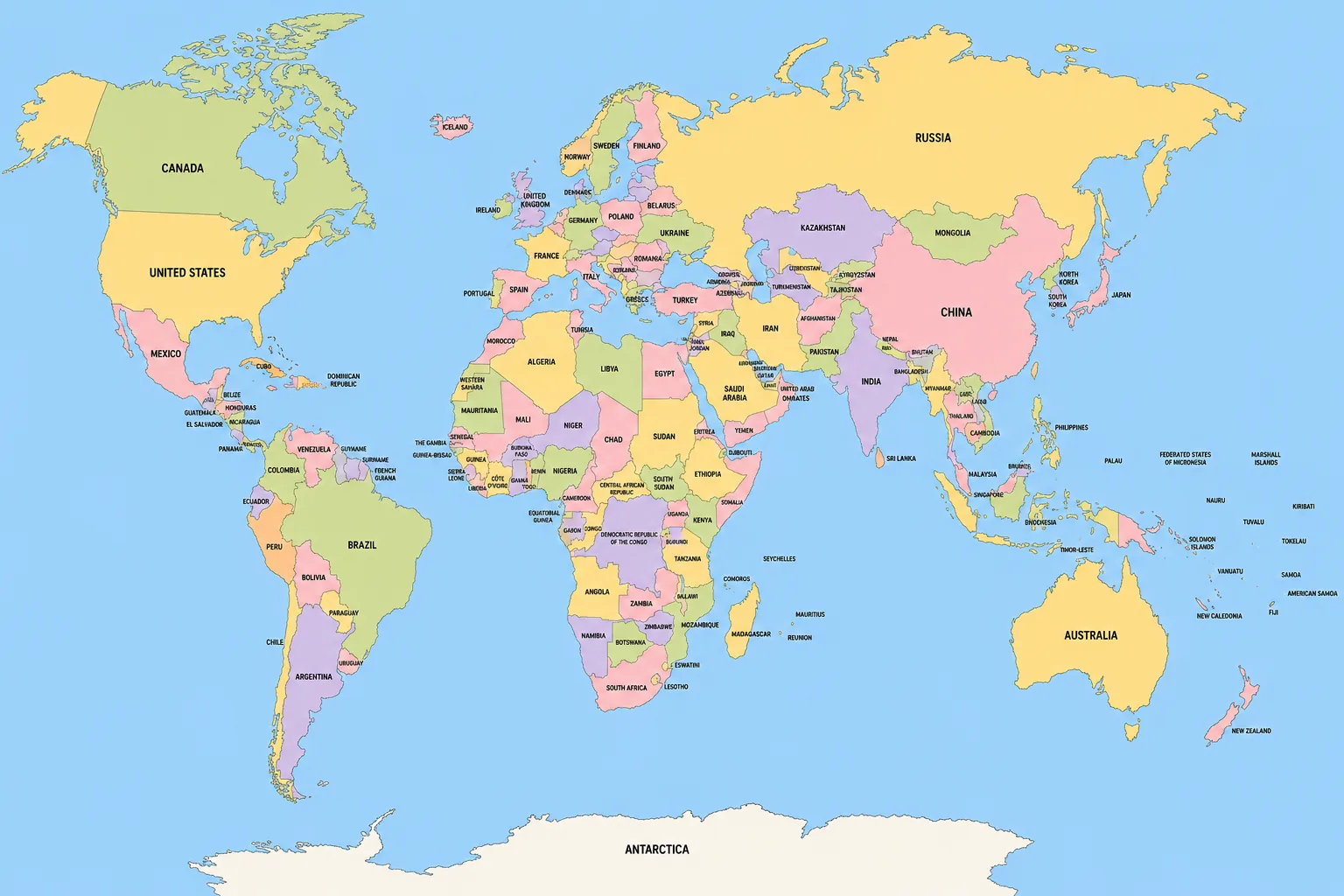
Over the past few weeks, we've gone continent by continent through the laws and customs governing corporate stamps and seals — from Ireland's genuinely mandatory common seal to Antarctica's total absence of any company law at all. Reading all seven at once would be a lot, so this post pulls together the single sharpest, most useful finding from each region, with direct links to the full deep-dive if you want the complete picture for a specific country you're dealing with.
If there's one thread running through every continent in this series, it's this: the legal requirement for a physical seal has been quietly disappearing almost everywhere for the last thirty years — the UK abolished it in 1989, Singapore in 2017, India in 2015, Kenya in 2020, Nigeria in 2020. But the seal itself hasn't disappeared from actual business practice nearly as fast as the law has moved. That gap — between what's legally required and what a bank, government office, or foreign counterparty still expects to see — is where nearly every practical mistake in this series happens. The safest place to stand, as it turns out, isn't picking a side of that gap — it's simply owning a properly made seal so the question never costs you anything either way.
Europe: One Continent, No Single Rule
Europe has no continental seal law at all — each country decided independently, and the results genuinely contradict each other next door to one another. The UK made its seal optional back in 1989. Ireland, right across the Irish Sea, still legally requires every registered company to have one. Switzerland never required one in the first place. The one thing moving the same direction everywhere: the EU's eIDAS 2.0 framework, rolling out a bloc-wide digital identity wallet with legally recognised electronic seals by the end of 2026.
Asia: Where the Seal Can Outrank the Signature
This is the continent where Western assumptions break down fastest. In China, a properly registered company chop can legally bind a business to a contract with no signature present at all — whoever holds it effectively holds practical control of the company. Japan's government eliminated hanko requirements from 99% of official procedures back in 2021, yet a survey as recent as late 2025 found 91% of Japanese schools still require one. The lesson: don't assume law and practice move at the same speed, especially here.
Africa: What CAMA 2020 Actually Changed at Home
For our own readers, this was the most important entry in the series. Nigeria's CAMA 2020 made the common seal optional, not mandatory — but what actually replaced it (Sections 101–103: signatures from a director and secretary, two directors, or a director before a witness, all carrying the same legal effect as a sealed document) matters more than the headline. Kenya made the same move, but only via a 2020 amendment — not, as often assumed, baked into its 2015 Companies Act from the start.
North America: The Delaware Exception Nobody Mentions
US and Canadian corporate seals are about as optional as they get anywhere in the world — Canada's own statute states a document "is not invalid merely because a corporate seal is not affixed to it." But Delaware and Massachusetts both still give sealed contracts a dramatically longer statute of limitations than unsealed ones (unlimited vs. three years, in Delaware's case) — a genuinely useful, rarely-mentioned exception for any long-term agreement governed by either state's law.
South America: The Notary, Not the Stamp, Signs Off
Company stamps are everywhere across South America — invoices, customs paperwork, tax filings — but it's almost always the authorised signature, and for high-stakes documents the notary, that actually makes something legally binding. Brazil is the standout on the digital side: its ICP-Brasil public key infrastructure is genuinely advanced, explicitly modelled on the EU's own eIDAS framework, and backed by real Superior Court rulings confirming its validity.
Australia & Oceania: A $1.5 Million Lesson in Getting Signatories Right
Australia's seal is almost entirely symbolic today — but a real property contract worth $1.5 million was thrown out by the courts not because of a missing seal, but because only one of the company's two directors had signed it. Across the wider Pacific, the pattern flips: Papua New Guinea, Fiji, and the Solomon Islands still lean on physical stamps heavily in day-to-day government and banking dealings, regardless of what the law technically allows.
Antarctica: The One Continent With No Company Law At All
Antarctica has no government, no companies, and no domestic legal system to speak of — so stamps and seals there serve science and institutional accountability rather than commerce, governed entirely by whichever home country operates a given research station, layered under the Antarctic Treaty System. It's a useful closing reminder of what a stamp or seal actually exists to do at its core, stripped of every commercial context: mark that someone with real, verifiable authority stood behind a document.
The Pattern Worth Remembering
Across all seven continents, three things stayed consistent regardless of legal tradition:
- The direction of travel is the same everywhere — toward optional seals and legally recognised electronic signatures, even in jurisdictions that still formally require a physical one today.
- Custody and authorisation matter more than the seal itself — nearly every real dispute referenced across this series (China's forged-chop cases, Australia's Knight Frank ruling) came down to who was authorised to act, not whether a seal was technically present.
- Local expectation regularly outlives local law — banks, customs offices, and government counters across Kenya, Poland, Ecuador, and dozens of other countries in this series keep asking for a stamp years after the underlying legal requirement was removed.
What This Means If You're Trading Internationally From Nigeria
CAMA 2020 gave Nigerian businesses the same flexibility this entire series has traced across the world — but flexibility isn't the same as irrelevance. If your next contract touches Ireland, Ghana, or Kenya, expect the seal question to matter more than you'd assume. If it touches the UK, Canada, Singapore, or Australia, expect it to matter far less than a signature done correctly. And if your business increasingly handles documentation digitally — invoices, contracts, cross-border correspondence — the direction every single continent in this series is heading makes a strong case for having a properly formatted digital stamp ready alongside your physical one, not as a someday project.
That's precisely the dual-track approach MALLAMIBRO KONCEPTS LTD builds for Nigerian businesses — precision-manufactured embossing seals for the counterparties and documents that still expect one, and high-resolution digital stamps and electronic seals (PNG, JPEG and PDF) for the growing share of business now happening entirely online.
This article is for general educational purposes only and does not constitute legal advice. Laws vary by country and change over time — businesses should seek jurisdiction-specific legal counsel before relying on any stamp or seal for the formal execution of documents. For the full detail and legislation citations behind each summary above, see the individual continent posts linked throughout.

Mallamibro Koncepts Ltd
Corporate stamps, seals, printing & branding — based in Ibadan, serving businesses nationwide.
Need Custom Stamps, Seals, or Branding?
Order online and we deliver safely anywhere in Nigeria, or walk into our Ibadan office and see the quality for yourself.