
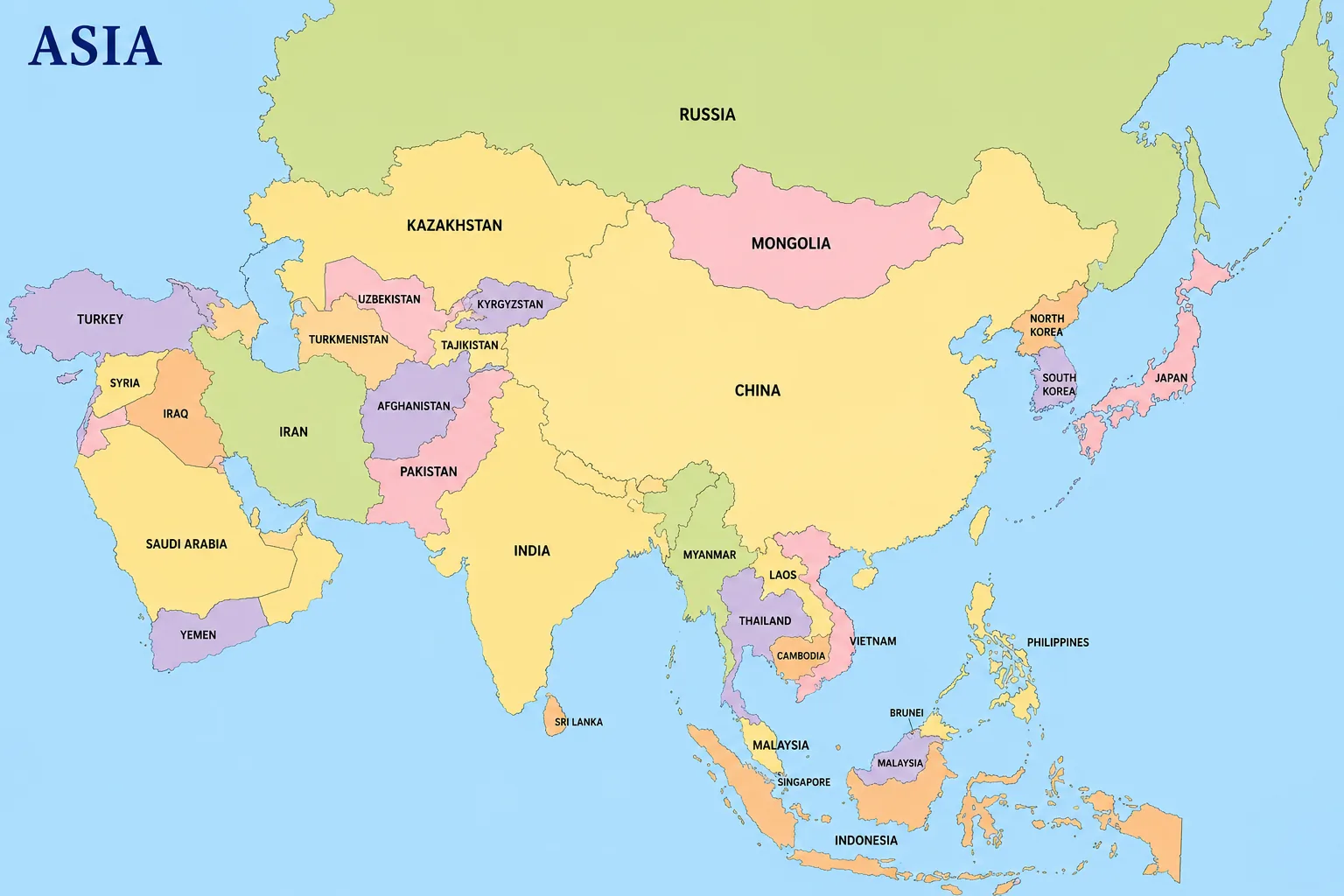
If Europe's approach to stamps and seals is a patchwork of "optional, mostly," Asia is a completely different conversation. Walk into a business meeting in Beijing, Tokyo, or Seoul, and the seal on the table often carries more legal weight than anyone's signature. For a Nigerian company sourcing from China, licensing technology from Japan, or exporting to the Gulf, understanding that difference isn't a cultural curiosity — it can be the difference between a contract that actually binds the other party and one that doesn't.
This post is part of our global stamps & seals series. See the full 7-continent summary for the complete picture.
China: Where the Seal Is the Company's Signature
China runs, without question, one of the most powerful seal systems in the world. The official company chop (公章) isn't a formality — under Chinese law, a document stamped with the registered company chop is treated as prima facie evidence of the company's consent, whether or not anyone's signature appears alongside it. Whoever physically holds the chop effectively holds the power to bind the company to contracts, financial obligations, and regulatory filings.
Every company chop must be produced by a licensed, government-authorised engraving vendor and filed with the Public Security Bureau (PSB) for it to carry legal recognition — an informal or unregistered chop is simply invalid. Most Chinese companies actually hold several distinct chops for different purposes: the official company chop (widest authority), a financial chop (banking and tax), a contract chop, an invoice/fapiao chop, and a legal representative's personal name chop — each restricted to its specific function, partly as an internal safeguard against a single point of failure. Forging a company chop is a criminal offence in China, punishable by up to three years in prison, and real disputes have hinged on exactly this: in 2020, a widely reported dispute between Tencent and a Chinese chili oil manufacturer traced back to individuals who had forged the company's chop to sign an unauthorised advertising contract.
Digitalisation hasn't bypassed this system — it's been folded into it. Under China's Electronic Signature Law (last revised 2019), a properly registered electronic chop carries the same legal validity as its physical counterpart, provided the underlying creation data is exclusively controlled by the signatory and any alteration is detectable. It's a good reminder that the value was never in the ink or the metal itself — it was always in who's allowed to hold it, a principle that holds whether you're guarding a Chinese chop or a freshly engraved Nigerian company seal locked in your own office drawer.
Ethical guideline: maintain strict custody records for every chop your company holds, and report any loss immediately to the Public Security Bureau — in China, delay isn't just risky, it can be the difference between limiting damage and losing control of the company's legal identity entirely.
Japan: A Government Reform That Culture Hasn't Fully Caught Up To
Japan's hanko and inkan culture runs deep — the practice dates back over a thousand years — and it produced one of the most dramatic (and still unfinished) modernisation pushes anywhere in Asia. In 2020, then-Minister for Administrative Reform Taro Kono announced plans to eliminate hanko requirements from government procedures entirely, famously declaring the government should "kill the hanko." Of roughly 14,900 types of administrative procedures that had required a hanko, over 99% no longer do today — only around 80 remain, mostly involving the registered personal seal (jitsuin), a bank-registered seal, or an official seal certificate, and these are still central to major transactions like property purchases and company registrations.
But here's the twist worth knowing: the reform reshaped government paperwork, not necessarily business or school culture. Over 90% of Japanese companies still use hanko in daily operations, and a Ministry of Education survey conducted as recently as late 2025 found that 91% of Japanese public schools still require documents to be stamped with a hanko despite an official government target to eliminate mandatory stamping. Japan's Act on the Use of Electronic Signatures (2000, amended since) gives properly executed e-signatures the same legal standing as a hanko, and e-seal platforms are growing — but for now, treat "digitalisation reduced mandatory use" as true on paper and still very much a work in progress in practice.
Ethical guideline: never use another person's registered seal, even with casual permission, and report a lost or stolen jitsuin to the local city office immediately — until you do, anyone who finds it can use it with your seal certificate.
South Korea: Dojang Culture, Slowly Meeting Digital Signatures
South Korea's personal and corporate seals — dojang — carry a similar cultural and practical weight to Japan's hanko, particularly in banking, property transactions, and formal corporate documentation. Electronic signatures are increasingly accepted for everyday commercial use, but for the transactions that matter most — property, banking mandates, major corporate resolutions — the physical dojang remains the default expectation.
Ethical guideline: restrict dojang access to specifically authorised personnel only, and never leave a corporate dojang in a drawer anyone in the office can reach — the same custody discipline that applies to a Chinese company chop applies here.
India: From Mandatory to Optional in a Single Amendment
Here's a nuance worth getting exactly right: the Companies Act 2013, as originally passed, actually required Indian companies to affix a common seal on specific documents — share certificates and bills of exchange among them. It was the Companies (Amendment) Act, 2015 that changed this, replacing references to "common seal" throughout the Act with "common seal, if any" — making it entirely optional. Since then, Indian companies can execute documents through two directors' signatures, a director and company secretary, or a recognised electronic signature instead.
In practice, plenty of Indian businesses still use a common seal anyway — it's a strong authenticity signal for banks, foreign counterparties, and formal agreements, even though the law no longer requires it. If a company's own Articles of Association still mandate a seal, that internal requirement continues to apply regardless of what the national law now permits.
Ethical guideline: whatever your Articles say, keep every seal use tied to an actual board resolution — an unauthorised seal impression is exactly the kind of thing that creates disputes years later.
Singapore: Abolished Cleanly, Kept Voluntarily
Singapore took the UK's playbook and applied it precisely. Effective 31 March 2017, under the Companies (Amendment) Act 2017, companies and LLPs are no longer required to use a common seal to execute deeds, share certificates, or any other document that previously demanded one. Execution by two authorised signatories (or one director before a witness) is now fully sufficient. Many Singapore companies still keep a seal for ceremonial purposes or because an overseas counterparty expects one, but legally, it's now entirely optional — joining Australia, Hong Kong, and the UK as jurisdictions that have made the same move.
Malaysia, Indonesia & Thailand: Law Loosening, Habit Holding Firm
Across much of Southeast Asia, the pattern is remarkably consistent: legal requirements for corporate seals and stamps have been gradually relaxed in favour of signatures and electronic execution, but institutional habit hasn't caught up nearly as fast. In Malaysia, corporate seals remain common in practice despite growing acceptance of signature-only execution. In Indonesia, company stamps (cap perusahaan) continue to play a significant administrative role in licensing and day-to-day business documentation. In Thailand, government offices and financial institutions frequently still request a company stamp alongside an authorised signature, even where the underlying law no longer strictly demands it. If you're transacting in any of these markets, the safest approach is to ask the specific counterparty or institution directly rather than assume either way.
Vietnam: From State-Controlled to Fully Self-Managed
Vietnam's evolution here is one of the clearest examples of deregulation in the region. Under the 2005 Enterprise Law, a company's seal had to be physically registered with the police, who issued a seal specimen certificate. The 2014 Enterprise Law relaxed this to a simple notification to the business registration authority. Then the 2020 Enterprise Law (effective January 1, 2021) removed even that — companies no longer need to register or notify their seal to any authority at all, and are free to decide their seal's shape, quantity, and content entirely through their own charter.
Just as significantly, the 2020 law formally recognises a compliant digital signature as a legitimate alternative form of "seal" — putting a physical stamp and a proper e-signature on genuinely equal legal footing for the first time. The trade-off: because seals are no longer publicly registered, a counterparty now has no central database to verify a Vietnamese company's seal against — making due diligence on the underlying signatory's authority more important than ever.
The Middle East (West Asia): Practical Weight in Government and Trade
Across the Gulf, the company stamp remains a practical fixture of doing business — government dealings, customs clearance, and trade documentation routinely expect one, and its absence can slow down processes that would otherwise move quickly. For any Nigerian exporter dealing with Gulf-based partners or customs authorities, this is one region where showing up without a proper company stamp isn't just a stylistic gap, it can be an operational one.
Ethical Guidelines for Using Stamps and Seals Across Asia
- Maintain strict custody controls — in seal-first jurisdictions like China, Japan, and South Korea, whoever holds the seal effectively holds practical control of the company. Treat custody accordingly.
- Keep usage registers — record date, purpose, and authorising officer for every use, physical or digital.
- Never imitate government seals — this is treated as a serious criminal matter across virtually every jurisdiction covered here, not a civil dispute.
- Immediately replace lost or stolen seals — and in jurisdictions with formal registration (China, Japan's jitsuin, South Korea), report the loss to the relevant authority the same day, not "when convenient."
- Establish clear authority levels for digital and physical seals alike — an electronic chop or e-seal deserves the same access controls as its physical counterpart, since several of the jurisdictions above now give both equal legal weight.
What This Means If You're a Nigerian Business Dealing With Asia
The single most important habit to build: never assume a document is "properly executed" just because it has a signature on it, if you're dealing with a Chinese, Japanese, or South Korean counterparty. Ask specifically whether their seal or chop is required, and if so, whether it's been affixed by someone actually authorised to do so — the seal itself won't tell you that. Conversely, don't assume every Asian counterparty needs a seal at all; Singapore and, increasingly, India have moved firmly toward signature-based execution.
For your own side of these transactions, having both a precision-manufactured physical seal and a properly formatted digital stamp ready to go means you're never scrambling regardless of which side of this divide your counterparty falls on. That's exactly the dual-track capability MALLAMIBRO KONCEPTS LTD builds for Nigerian businesses trading internationally — embossing seals manufactured to exact specification for the partners who still expect one, and high-resolution digital stamps and electronic seals (PNG, JPEG and PDF) for the growing number who don't.
This article is for general educational purposes only and does not constitute legal advice. Laws vary by country and change over time — businesses should seek jurisdiction-specific legal counsel before relying on any stamp or seal for the formal execution of documents.
Mallamibro Koncepts Ltd
Corporate stamps, seals, printing & branding — based in Ibadan, serving businesses nationwide.
Need Custom Stamps, Seals, or Branding?
Order online and we deliver safely anywhere in Nigeria, or walk into our Ibadan office and see the quality for yourself.