
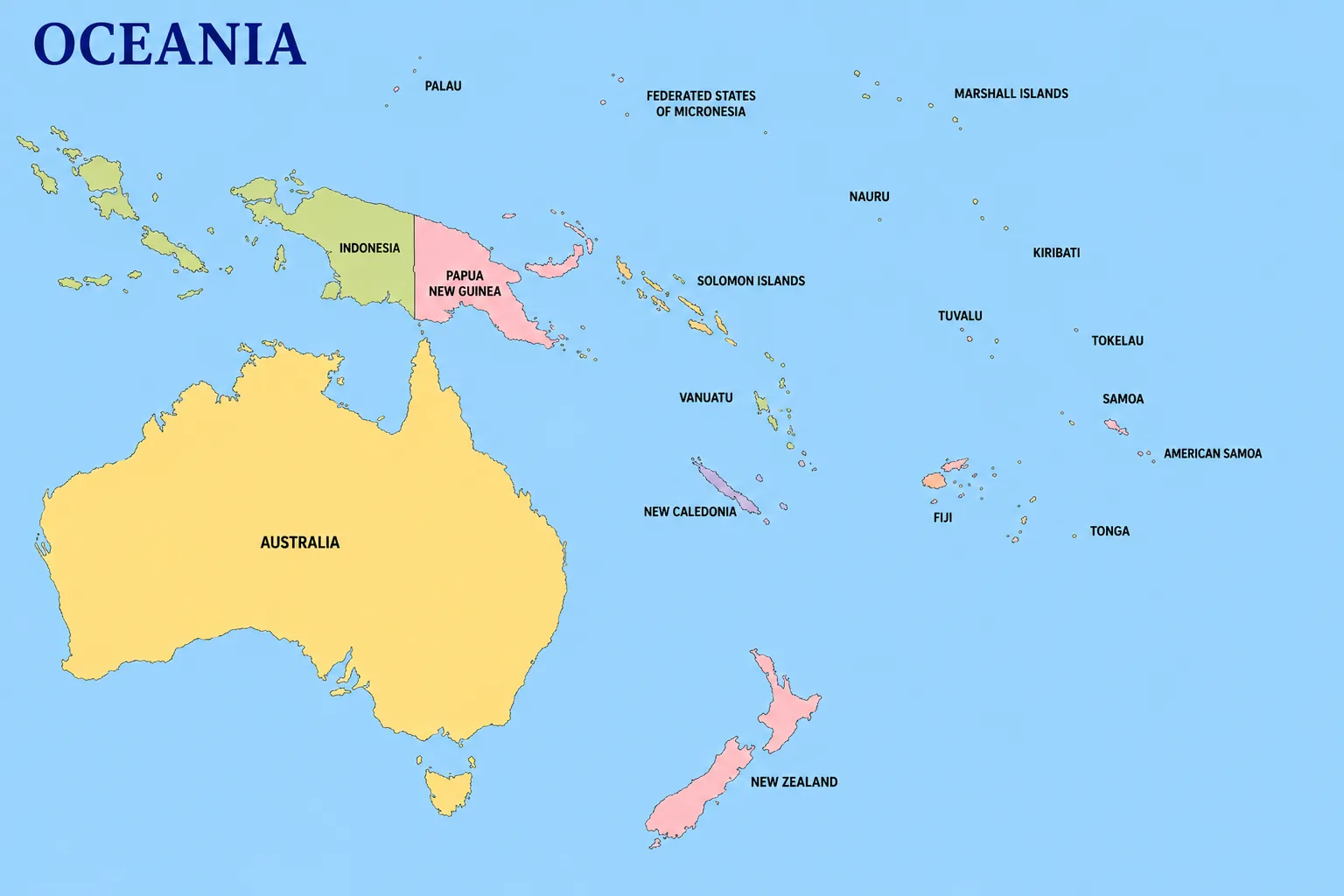
Australia and New Zealand are two of the clearest examples anywhere in the world of a legal system that has almost entirely moved on from the company seal — while the Pacific Island nations around them tell a more mixed story, still leaning on stamps for a lot of day-to-day government and banking interaction.
This post is part of our global stamps & seals series. See the full 7-continent summary for the complete picture.
Australia: Optional by Law, but Get the Details Right
Section 123 of the Corporations Act 2001 confirms a company "may have a common seal" — it's entirely optional. Where a company does use one, its name and Australian Company Number (or, in specific circumstances, its ABN) must appear on it, and using a non-compliant seal is a strict liability offence.
The real action, though, is in Section 127, which sets out how companies execute documents whether or not they have a seal: signature by two directors, a director and company secretary, or a sole director (with recent reforms making this easier for single-director companies). Get this right and the other party gets the benefit of a "statutory assumption" under Section 129 — they can rely on the document being properly executed without digging into your internal records. Get it wrong, and the consequences are real: in Knight Frank Australia Pty Ltd v Paly Properties, a $1.5 million property contract was found unenforceable because only one of the purchaser company's two directors had signed it, and there was no evidence the signing director had separate authority to act as the company's agent. The seal itself is now rarely the issue in Australian corporate disputes — getting the signatory combination right is what actually matters. It's a small irony worth sitting with: a $1.5 million deal was undone not by a missing piece of engraved metal, but by a missing name — precision, in the end, mattering far more than ceremony.
New Zealand: No Seal Required, With One Interesting Exception
The Companies Act 1993 removed the seal requirement for companies entirely — documents executed by authorised directors remain valid without one, and the Act doesn't even prescribe what a seal should look like if a company chooses to keep one. Some companies still maintain seals for ceremonial purposes, share certificates, or because an overseas trading partner in Asia or the Middle East expects to see one on export documentation, even though New Zealand itself doesn't require it.
Here's the interesting exception: incorporated societies (clubs, charitable organisations, and similar bodies, as opposed to companies) are a different legal category entirely, and many were still required to maintain a common seal for executing formal contracts under older legislation — a genuine gap between how companies and societies are treated under New Zealand law. The Law Commission has recommended closing that gap by extending the same seal-optional approach to societies, so this is worth double-checking against the current version of the relevant Act if you're dealing with an NZ incorporated society specifically rather than a company.
Papua New Guinea, Fiji & Solomon Islands: Stamps Still Doing Real Work
Across Melanesia, company stamps remain a genuinely practical part of doing business. In Papua New Guinea, stamps show up constantly in commercial administration, customs procedures, and government dealings. Fijian businesses use them regularly for banking documentation, licensing procedures, and government correspondence. In the Solomon Islands, corporate stamps continue to carry real practical importance in trade documentation and public sector transactions — this is a part of the world where the law may have relaxed, but the counter clerk hasn't necessarily caught up.
Vanuatu & Samoa: Offshore Structuring Keeps the Seal Relevant
Vanuatu is a notable offshore financial centre, and international business companies structured there frequently maintain seals specifically for offshore corporate administration and cross-border dealings — the seal here is less about domestic legal necessity and more about satisfying the expectations of the international banks and counterparties such structures typically deal with. Samoan companies, similarly, continue encountering seals regularly in corporate governance and financial transactions.
Tonga, Kiribati, Tuvalu & Nauru: Colonial Common Law, Practical Persistence
Tongan organisations commonly maintain official stamps for formal documentation and government interactions. Kiribati, Tuvalu, and Nauru all inherited common law traditions from former colonial administrations, and while the specifics vary by jurisdiction, all three continue to see practical, everyday use of company stamps in business administration regardless of what the strict legal position technically requires.
Notarial Seals: Still the Serious Business Across Oceania
Regardless of how relaxed a given country's company-seal rules have become, notarial seals remain genuinely important across the whole region — international declarations, powers of attorney, sworn affidavits, and overseas property transactions routinely still require one, even in Australia and New Zealand where corporate seals themselves have become close to symbolic.
Digital Authentication: Australia and NZ Lead, the Pacific Follows
Australia and New Zealand rank among the more digitally advanced jurisdictions globally for electronic signatures and document execution — Australia has embedded permanent reforms allowing deeds and other formal documents to be executed electronically, provided the method reliably identifies the signer and preserves document integrity. Government agencies in both countries increasingly accept electronic authentication for commercial transactions as standard practice, well ahead of where much of the wider Pacific region currently sits.
Ethical Guidelines for Using Stamps and Seals Across Australia and Oceania
- Never apply a company seal without proper authority — and just as importantly in Australia specifically, make sure your signatory combination actually matches your company's real director/secretary structure.
- Restrict custody of seals to designated officers — treat the seal as a controlled asset, not office stationery.
- Maintain usage records for physical and digital seals — date, purpose, and authorising officer for every use.
- Replace outdated seals immediately following company changes — a seal reflecting an old company number or name creates real confusion, and in Australia specifically, using a non-compliant seal is a strict liability offence.
- Never imitate government emblems or official notarial seals — this is treated seriously across every jurisdiction in the region.
- Protect digital seal files against unauthorised access — especially relevant given how far ahead Australia and NZ are on electronic execution.
- Establish clear internal policies governing seal use — don't leave signatory authority ambiguous the way the losing party did in Knight Frank v Paly Properties.
What This Means for Nigerian Businesses
If you're dealing with an Australian or New Zealand counterparty, don't expect a seal at all — a properly executed signature block is what will actually bind them, and it's worth knowing enough about their execution requirements (particularly Australia's Section 127 combinations) to avoid the kind of dispute that sank the Knight Frank contract. If you're trading with Papua New Guinea, Fiji, or the smaller Pacific nations, the opposite applies — bring your stamp, because it's still genuinely expected in day-to-day dealings there. And if a Vanuatu or Samoan offshore structure is involved, assume a seal is part of the standard toolkit for that kind of relationship.
Whichever direction a given transaction pulls, having both a precision-manufactured physical seal and a properly formatted digital stamp on hand means you're ready either way. That's exactly the dual-track capability MALLAMIBRO KONCEPTS LTD builds for Nigerian businesses trading internationally — embossing seals to exact specification, and high-resolution digital stamps and electronic seals (PNG, JPEG and PDF) for the digital-first side of the relationship.
This article is for general educational purposes only and does not constitute legal advice. Laws vary by country and change over time — businesses should seek jurisdiction-specific legal counsel before relying on any stamp or seal for the formal execution of documents.

Mallamibro Koncepts Ltd
Corporate stamps, seals, printing & branding — based in Ibadan, serving businesses nationwide.
Need Custom Stamps, Seals, or Branding?
Order online and we deliver safely anywhere in Nigeria, or walk into our Ibadan office and see the quality for yourself.