
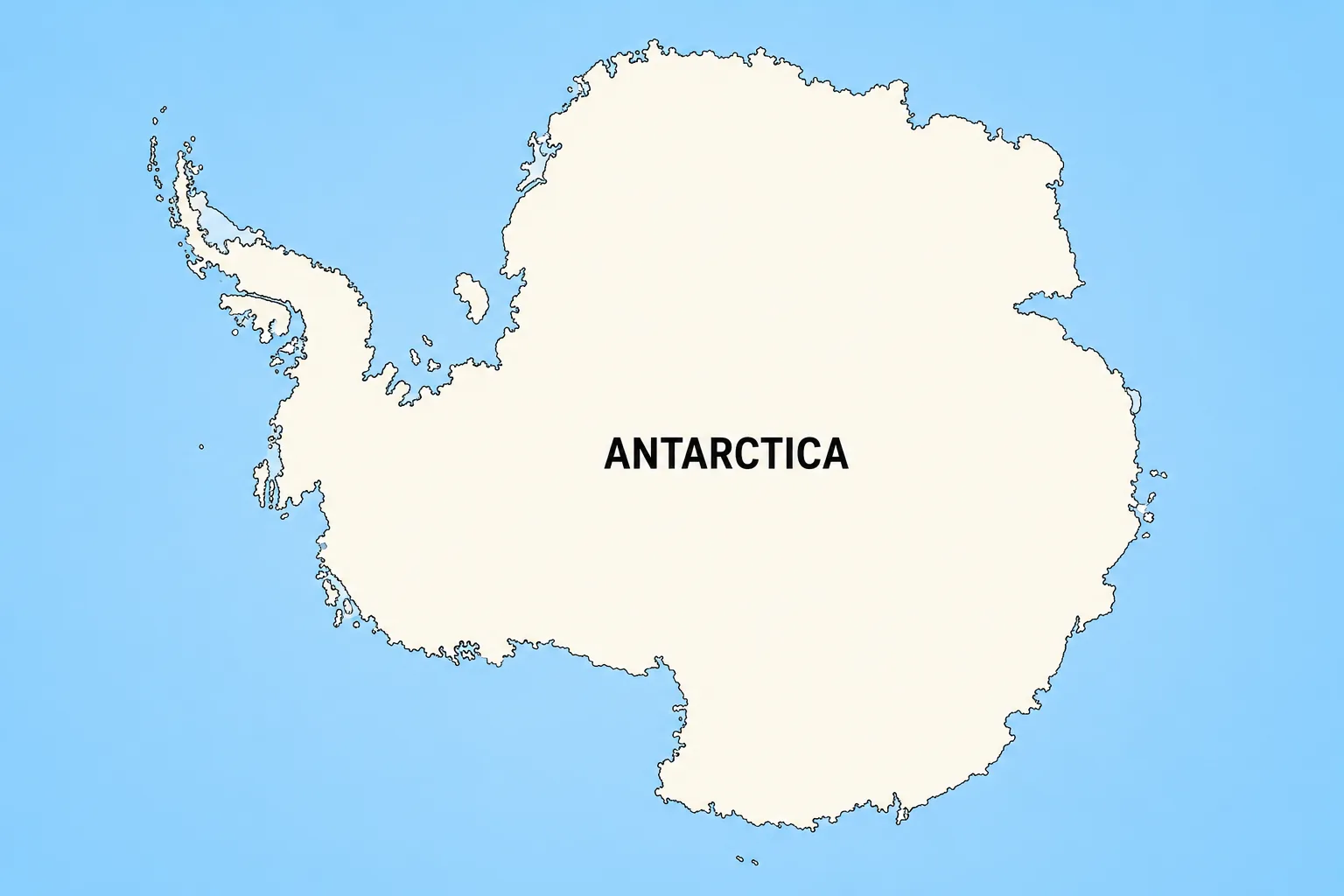
Before we get into it, a quick note on why this entry looks different from the other six in this series: Antarctica has no sovereign government, no permanent population, and — this is the important part for a series about corporate stamps and seals — no domestic company law of its own. There's no "Antarctic Companies Act" to compare against Nigeria's CAMA 2020, because there's no Antarctic corporate registry, no Antarctic banks, and no Antarctic businesses in the ordinary sense. Rather than force a comparison that doesn't exist, this post covers what actually governs documentation and authentication on the continent — which turns out to be a genuinely interesting story in its own right.
This post is part of our global stamps & seals series. See the full 7-continent summary for the complete picture.
The Antarctic Treaty System: What Actually Governs the Continent
The Antarctic Treaty was signed in Washington on 1 December 1959 by the twelve countries whose scientists had been active in the region during the 1957–58 International Geophysical Year — Argentina, Australia, Belgium, Chile, France, Japan, New Zealand, Norway, South Africa, the Soviet Union, the United Kingdom, and the United States. It entered into force on 23 June 1961, reserving the entire continent south of 60° South Latitude exclusively for peaceful purposes and scientific research, and banning military bases, nuclear testing, and new territorial claims.
As of 2024, the Treaty has 58 state parties. Twenty-nine of them, including all twelve original signatories, hold full "consultative" (voting) status, earned by demonstrating substantial ongoing research activity on the continent. The remaining parties attend the annual Antarctic Treaty Consultative Meeting but don't vote on decisions. A related agreement worth knowing about — the Madrid Protocol — bans commercial mining outright, with that ban only reviewable from 2048 onward, and even then only if every consultative party agrees to a binding replacement regime first. In other words: don't expect an "Antarctic business boom" to change any of this within your working lifetime.
How Documentation Actually Gets Authenticated There
Because there's no local jurisdiction to defer to, research stations operating in Antarctica remain governed, in almost all administrative and legal matters, by the laws of whichever country actually operates that station. A scientist working at a British Antarctic Survey station is still operating under UK administrative law; someone at a US station falls under US federal rules; and so on for every national programme present on the continent.
In practice, this means official institutional stamps still get used regularly — just not for commercial purposes. You'll find them on scientific reports, equipment inventories, logistics documentation, customs declarations, personnel records, research permits, and environmental compliance records. Critically, these stamps are issued by universities, government agencies, and scientific organisations, not private businesses, and their authority flows entirely from the home country's own institutional rules, not from anything specific to Antarctica itself.
The National Programmes
Each country with an active Antarctic presence runs its own program, and each follows its own home country's laws and internal governance policies for anything involving official seals or institutional authentication — there's no unified "Antarctic seal standard." Some of the more prominent ones: the United States Antarctic Program, the British Antarctic Survey, the Australian Antarctic Division, the South African National Antarctic Programme, the Chinese Antarctic Research Programme, and the Indian Antarctic Programme, among the roughly two dozen other national programmes now active across the continent.
Legal Documents: Always Imported, Never Local
Any genuinely legal document used in connection with Antarctic activity — powers of attorney, employment contracts, customs declarations, medical documentation, insurance records, international shipping paperwork — originates from, and continues to follow, the requirements of whichever external jurisdiction issued it. There's no way around this: since Antarctica has no domestic legal system of its own to originate documents from, every legal instrument used there is, by definition, imported.
Postal Cachets and Commemorative Stamps: A Different Kind of "Stamp" Entirely
Here's a fun tangent worth knowing, if only because the terminology overlap causes genuine confusion: Antarctic research stations and national programmes have a long tradition of issuing commemorative expedition postal cachets and special postmarks — collectible, historically significant, and popular with philatelists worldwide. These are an entirely different category from the corporate/institutional stamps discussed above. They carry no legal or corporate authority whatsoever; they're purely philatelic and historical artefacts, souvenirs of having actually been there, not authentication tools.
Digital Authentication: Essential, Not Optional
Given Antarctica's extreme remoteness and the genuinely international nature of most research collaboration happening there, modern Antarctic operations lean heavily on secure electronic document systems, digital signatures, and encrypted communications — arguably more essential here than on any other continent in this series, simply because physically transporting paper documents in and out of the region is logistically difficult in a way it simply isn't anywhere else on Earth.
Ethical Guidelines for Stamps and Seals in Antarctica
- Never use institutional stamps without authorisation — the same custody discipline that applies to a corporate seal anywhere else applies to a research station's official stamp.
- Maintain secure custody of official seals — restrict access to designated personnel.
- Keep records of seal usage for audit purposes — particularly important given how much Antarctic research funding and compliance is externally audited.
- Never imitate government insignia or treaty-related emblems — this remains a serious matter even in a jurisdiction with no domestic criminal court of its own; the relevant home country's law still applies.
- Protect digital authentication tools from unauthorised access — especially critical given how central digital systems are to Antarctic operations generally.
- Follow both home-country regulations and Antarctic Treaty obligations simultaneously — the two systems operate in parallel, not as alternatives to each other.
What This Actually Means (Including for Nigerian Businesses)
Antarctica demonstrates something genuinely useful for this whole series, even though it's not a market MALLAMIBRO KONCEPTS LTD or any ordinary Nigerian business will ever transact in: stamps and seals serve a purpose broader than commerce. On the world's southernmost continent, they exist to support science, international cooperation, and administrative accountability — not sales, contracts, or corporate authentication. It's a useful reminder, closing out this series, of what a stamp or seal is actually for at its core: a mark of institutional accountability, applied by someone with real authority to apply it, recorded and controlled properly — whether that institution is a Nigerian company registered under CAMA 2020, or a research station operating three degrees from the South Pole.
This article is for general educational purposes only and does not constitute legal advice. Antarctica has no domestic company law; all legal and institutional matters described here are governed by the relevant home country's regulations and the Antarctic Treaty System. Businesses should seek jurisdiction-specific legal counsel for any documentation genuinely connected to Antarctic activity.

Mallamibro Koncepts Ltd
Corporate stamps, seals, printing & branding — based in Ibadan, serving businesses nationwide.
Need Custom Stamps, Seals, or Branding?
Order online and we deliver safely anywhere in Nigeria, or walk into our Ibadan office and see the quality for yourself.