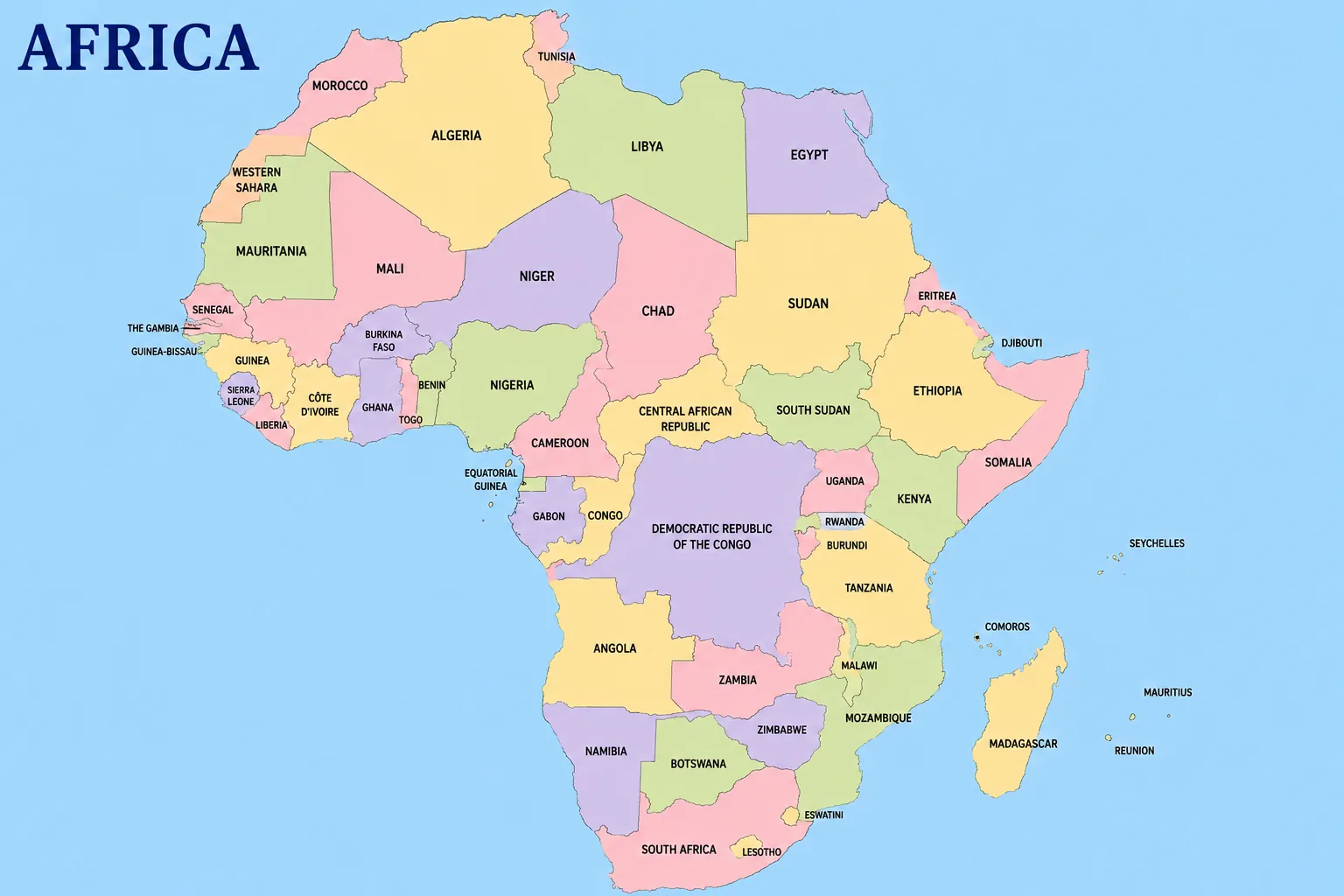
Africa is the one continent on this list where we don't have to speak in the abstract — this is home turf. If you run a business in Nigeria, you've almost certainly wondered at some point whether your company seal is a genuine legal necessity or just a formality your accountant insisted on. The honest answer, and the answer for most of the continent's biggest economies, has shifted meaningfully in the last decade — and getting it right matters, because Africa's legal landscape spans English common law, French civil law, Roman-Dutch law, and Islamic law, sometimes within the same region.
This post is part of our global stamps & seals series. See the full 7-continent summary for the complete picture.
Nigeria: From Mandatory to Optional, and What Actually Replaced It
Let's start where it matters most for our readers. Under the old Companies and Allied Matters Act of 1990, every Nigerian company was required to have a common seal, and its use governed the company's Articles of Association. That changed with CAMA 2020: Section 98 now states plainly that a company "may have a common seal, but need not have one." Where a company does keep a seal, the design and use are regulated by its own articles, and the company name must be engraved on it in legible characters.
What replaced the mandatory seal is worth knowing in detail, because it's genuinely useful for day-to-day operations. Under Sections 101–103 of CAMA 2020:
- A document requiring authentication may be signed by a director, secretary, or other authorised officer — no seal required.
- A document executed as a deed can be signed by two directors, a director and secretary, or a director in the presence of a witness who attests the signature.
- An electronic signature is expressly recognised as satisfying the requirement for signing.
- Documents executed this way carry the same legal effect as if they'd been executed under the company's common seal.
In practice, plenty of Nigerian businesses — including corporate clients we work with directly — still choose to use a seal for contracts, banking documentation, deeds, and general corporate identity purposes, even though CAMA 2020 no longer requires it. It remains a strong authenticity signal for banks and larger commercial counterparties, and Nigerian courts have long recognised that a seal, while not obligatory, still carries genuine evidentiary weight when properly used.
South Africa: No Seal Requirement Since the 2008 Overhaul
South Africa's Companies Act 71 of 2008, which replaced the older 1973 Act, doesn't impose any common seal requirement on companies at all. Businesses remain free to adopt and use a seal for internal governance or commercial purposes if they choose to — it's simply not a statutory obligation the way it was under older company law traditions.
Kenya: A More Recent Change Than You Might Think
Here's a correction worth making precisely: it wasn't the Companies Act, 2015 itself that made Kenya's common seal optional — that Act still contemplated seal-based execution for certain documents. The real shift came via the Business Laws (Amendment) Act, 2020, which amended Sections 35 and 37 of the Companies Act. Since then, a Kenyan company can execute a document simply by having it signed on the company's behalf by an authorised person, with no seal required at all. The reform was explicitly aimed at cutting the cost and hassle of sealing devices and red wafers — though certain older statutes, like Kenya's Law of Contract Act, still reference sealed execution in specific contexts, so it's worth checking the exact document type before assuming a signature alone will always do.
Ghana: Optional by Design
Ghana's Companies Act, 2019 (Act 992) takes the same conditional approach as several jurisdictions above: Section 125 refers to a company seal only "where the company has" one, and where it does, the company name must be engraved in legible characters. Share certificates specifically may be issued either under the common seal or certified by two directors — giving Ghanaian companies the same flexibility Nigeria's CAMA 2020 introduced.
Egypt, Morocco, Algeria & Tunisia: Stamps Persist Regardless of Legal Tradition
Across North Africa, company stamps remain a genuinely practical fixture of doing business, particularly in banking, customs, and government transactions — and this holds true even as digitisation efforts advance. In Morocco, Algeria, and Tunisia specifically, the influence of French civil law traditions means official company stamps remain a common, often expected, part of formal business documentation, similar to what we saw in mainland France itself.
Ethiopia, Rwanda, Uganda & Tanzania: Digital Reform Meeting Institutional Habit
This is a pattern we've now seen on nearly every continent, and East Africa is no exception. In Ethiopia, government interactions and licensing procedures frequently still involve official company stamps as a practical matter. Rwanda has pushed hard on digital transformation initiatives that are gradually reducing dependence on physical stamps — but plenty of institutions still request them regardless. In Uganda and Tanzania, company stamps remain common in public procurement, banking, and regulatory compliance, even where the underlying legal requirement has softened. Old habits, it turns out, tend to outlive old laws — which is exactly why a well-made seal remains a better investment than a bet on how fast a given ministry updates its expectations.
Mauritius, Botswana, Namibia & Zambia: Optional, But Popular
This group shares a common thread: company seals are generally optional under current law, but businesses keep using them anyway. In Mauritius, seals remain popular for contracts and formal documentation despite not being mandatory. In Botswana, Namibia, and Zambia, businesses frequently retain seals for governance and international transactions, even as signature-based execution becomes more widely accepted — largely because international counterparties and older institutional relationships still expect to see one.
Ethical Guidelines for Using Stamps and Seals Across Africa
- Never use a company seal without proper authority — tie every use to an actual board resolution or documented director approval.
- Store seals securely — restrict physical access to designated officers only.
- Keep a seal usage register — record date, purpose, and authorising officer for every use.
- Replace lost or damaged seals immediately — an outdated or compromised seal creates real risk the longer it stays in circulation.
- Never imitate government insignia or official emblems — across every jurisdiction covered here, this crosses from a business matter into a criminal one.
- Restrict digital seal access to authorised officers only — the same custody discipline that applies to a physical seal applies to its digital equivalent.
What This Means for Nigerian Businesses
For a Nigerian business, the practical takeaway is this: CAMA 2020 gave you flexibility, not a reason to be careless. You're no longer legally required to maintain a common seal, but for contracts with banks, larger corporate partners, or counterparties in jurisdictions like Kenya or Ghana where sealed documents still carry weight, having a properly manufactured seal ready — alongside signature-based execution — keeps you covered either way. And if you're dealing with partners across North Africa or East Africa specifically, don't assume digitisation has fully replaced the stamp yet; in practice, it usually hasn't.
This is exactly why MALLAMIBRO KONCEPTS LTD manufactures both precision embossing seals and high-resolution digital stamps — so whichever side of Africa's optional-but-still-expected seal culture your next transaction falls on, you're not scrambling to catch up.
This article is for general educational purposes only and does not constitute legal advice. Laws vary by country and change over time — businesses should seek jurisdiction-specific legal counsel before relying on any stamp or seal for the formal execution of documents.
Mallamibro Koncepts Ltd
Corporate stamps, seals, printing & branding — based in Ibadan, serving businesses nationwide.
Need Custom Stamps, Seals, or Branding?
Order online and we deliver safely anywhere in Nigeria, or walk into our Ibadan office and see the quality for yourself.