
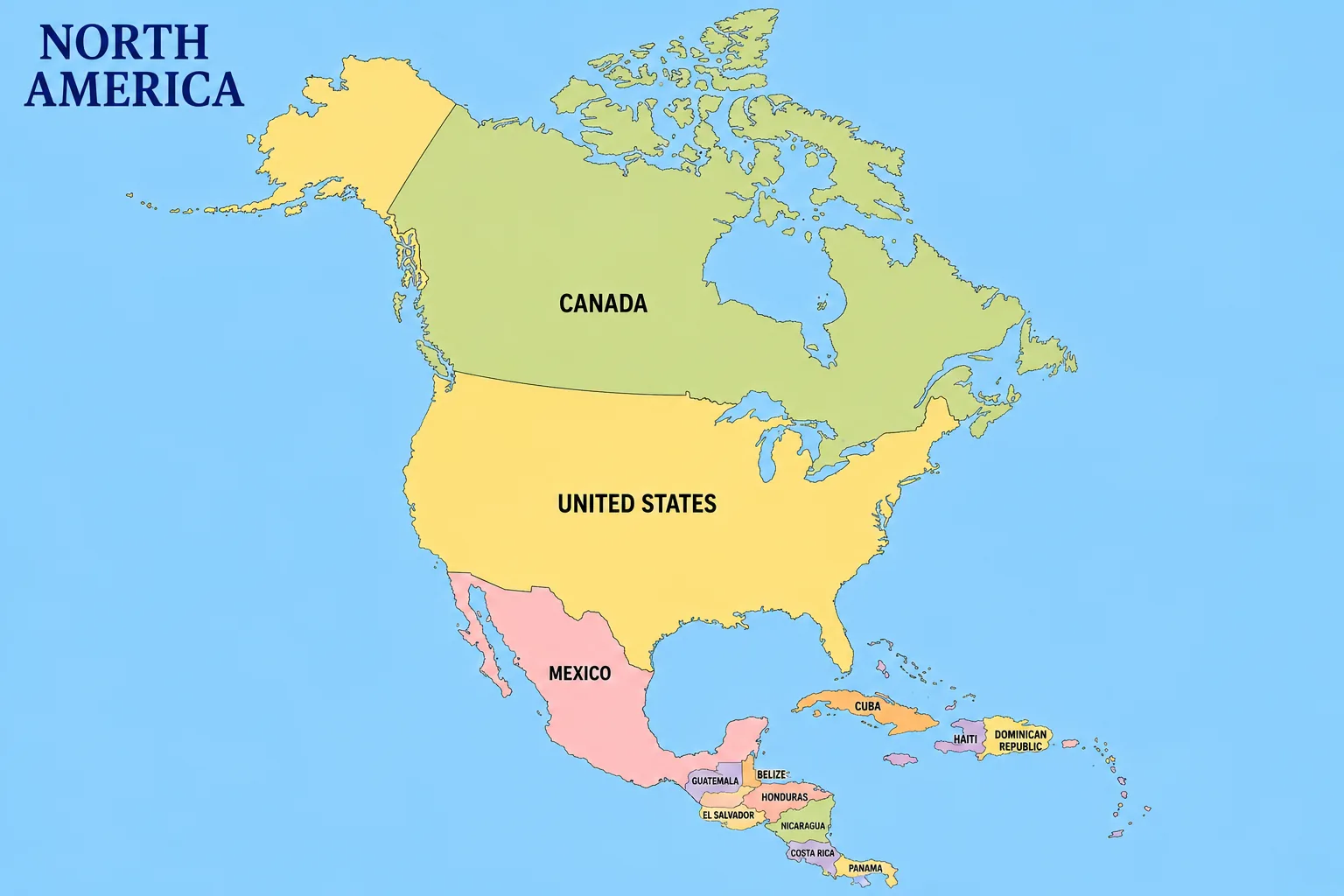
North America tells a consistent story: the corporate seal used to be everything, and now it's almost nothing — legally speaking, at least. But "almost nothing" isn't "nothing," and the exceptions are specific enough that a Nigerian business exporting to the US, incorporating a Canadian subsidiary, or dealing with a Mexican notary needs to know exactly where those exceptions sit.
This post is part of our global stamps & seals series. See the full 7-continent summary for the complete picture.
United States: Optional Everywhere, With One Genuinely Surprising Exception
Modern US corporate law has settled this question firmly in favour of the signature. The Model Business Corporation Act (MBCA) — the template that most US states base their corporate statutes on — treats a corporate seal as something a company "may but need not" have, meaning its absence doesn't affect a document's validity. States that don't formally follow the MBCA have generally arrived at the same place through their own statutes; California's Civil Code, for instance, explicitly states there's no legal distinction between a sealed and an unsealed document.
Here's the surprising exception worth knowing, because it's genuinely useful and rarely mentioned: in Delaware, a written contract executed under seal has no statute of limitations at all, while an unsealed contract is limited to three years. Massachusetts runs a similar system — twenty years for a sealed contract versus six for an unsealed one. For long-term agreements governed by Delaware or Massachusetts law specifically, the old-fashioned seal can still carry real, practical legal weight that a signature alone doesn't replicate.
Outside of that narrow use case, seals in the US today show up mostly by institutional habit — some banks still request them on account-opening documents, some government contracting offices reference them in procurement paperwork written decades ago, and some international counterparties simply expect to see one. Stock certificates, real estate transactions, and certain government filings are the most common places you'll still encounter a seal in practice — a bit like a family heirloom nobody uses daily but everyone still expects to see brought out for the big occasions.
Canada: About as Clear-Cut as Legal Language Gets
Section 23 of the Canada Business Corporations Act (CBCA) is refreshingly direct: "A corporation may, but need not, adopt a corporate seal," and a document "is not invalid merely because a corporate seal is not affixed to it." Ontario's Business Corporations Act uses near-identical language. In practice, many Canadian lawyers report going years without ever using one — banks that used to insist on sealed documents largely don't anymore.
That said, plenty of Canadian corporations still keep a seal on hand for share certificates, board resolutions, and international transactions, particularly when dealing with counterparties in jurisdictions where a seal still carries more weight than it does domestically.
Mexico: The Notary, Not the Stamp, Does the Heavy Lifting
Mexican business practice runs on a fundamentally different authentication model than its northern neighbours — one built around the Notary Public (Notario Público) rather than the company seal. This isn't the same role as a US notary. A Mexican Notary Public must be a practising attorney with a minimum of five years' experience, must pass a rigorous technical examination, and is personally appointed by the Governor of the state in which they'll practise. For company incorporation, bylaw changes, real property transfers, and powers of attorney, a Notary's certification — not a company stamp — is what actually makes a document legally binding in Mexico.
Company stamps still show up for administrative and internal purposes — invoices, internal correspondence, day-to-day paperwork — but they carry no special legal authority. For any Nigerian business incorporating or transacting in Mexico, budget for notary involvement as a genuine legal requirement, not an optional formality.
The Caribbean: Common Law Heritage, Gradual Change
Most Caribbean nations inherited British common law traditions and, broadly, have followed the UK's own trajectory away from mandatory corporate seals — though the pace and completeness of that shift varies by jurisdiction, and it's worth confirming the specific current position for whichever territory you're dealing with rather than assuming uniformity across the region.
In Jamaica, companies commonly maintain seals for corporate governance and international transactions even where not strictly mandated. In Trinidad and Tobago, corporate seals remain common in practice despite growing acceptance of electronic execution methods. In the Bahamas — a major hub for offshore and international corporate structuring — financial institutions frequently still encounter and request company seals as part of standard account and structure documentation, reflecting the international, cross-border nature of much Bahamian corporate activity.
Across the wider Caribbean, banks, customs authorities, and government agencies may continue requesting company stamps even where the underlying company law has relaxed — the same "law loosened, habit persisted" pattern we've seen play out on nearly every continent covered in this series.
Notarial Seals: Still the Load-Bearing Wall
Whatever a jurisdiction has decided about ordinary corporate seals, notarial seals remain genuinely important across all of North America — affidavits, real estate transfers, powers of attorney, and sworn declarations routinely require one. This holds true even in the US and Canada, where corporate seals themselves have become almost entirely optional. Mexico takes this furthest of all, building its entire company-formation and property-transfer system around notarial authority rather than a company stamp.
Digital Seals and Electronic Signatures
Electronic signatures carry real legal weight across North America. In the US, the federal ESIGN Act and the state-level Uniform Electronic Transactions Act (UETA) give electronic signatures the same legal standing as handwritten ones for most commercial purposes. Canada and Mexico have their own equivalent frameworks. The practical effect: for the vast majority of routine business documents across the continent, a properly executed electronic signature has already replaced whatever role a physical seal once played — the seal survives mainly in the specific pockets (Delaware/Massachusetts contract law, Mexican notarial acts, certain offshore Caribbean structures) called out above.
Ethical Guidelines for Using Stamps and Seals Across North America
- Never apply a company seal without proper authority — tie every use to a documented board or officer authorisation.
- Restrict custody to designated officers — a seal anyone in the office can access isn't meaningfully controlled.
- Maintain usage logs for physical and digital seals alike — record date, purpose, and authorising officer.
- Replace damaged or obsolete seals promptly — an outdated seal creates unnecessary risk the longer it stays in use.
- Never imitate government seals or official insignia — this is treated as a serious matter, not a civil dispute, across every jurisdiction covered here.
- Protect digital seal files against unauthorised access — the same custody discipline that applies physically should apply to the file itself.
What This Means for Nigerian Businesses
If you're transacting with a US or Canadian counterparty, don't be surprised if they've never used a corporate seal in their life — a signature will almost always be sufficient on their end. The one place to slow down: if your contract happens to be governed by Delaware or Massachusetts law and runs long-term, a properly sealed document could genuinely be worth the extra step given the statute-of-limitations difference. If you're setting up any kind of presence in Mexico, budget time and cost for notary involvement — it isn't optional the way a seal is elsewhere on this continent. And if you're dealing with Caribbean banks or offshore structures, don't assume the seal has disappeared just because the law technically allows it to.
Whichever of these situations you find yourself in, having both a precision-manufactured physical seal and a properly formatted digital stamp ready means you're never the one scrambling. That's the exact dual-track capability MALLAMIBRO KONCEPTS LTD builds for Nigerian businesses trading internationally — embossing seals to exact specification, and high-resolution digital stamps and electronic seals (PNG, JPEG and PDF) for the growing share of transactions handled entirely online.
This article is for general educational purposes only and does not constitute legal advice. Laws vary by country and change over time — businesses should seek jurisdiction-specific legal counsel before relying on any stamp or seal for the formal execution of documents.
Mallamibro Koncepts Ltd
Corporate stamps, seals, printing & branding — based in Ibadan, serving businesses nationwide.
Need Custom Stamps, Seals, or Branding?
Order online and we deliver safely anywhere in Nigeria, or walk into our Ibadan office and see the quality for yourself.